STANDARDS
Check best practices and design-system standards.
04 / DESIGN ENABLEMENT
Shared research standards & team systems
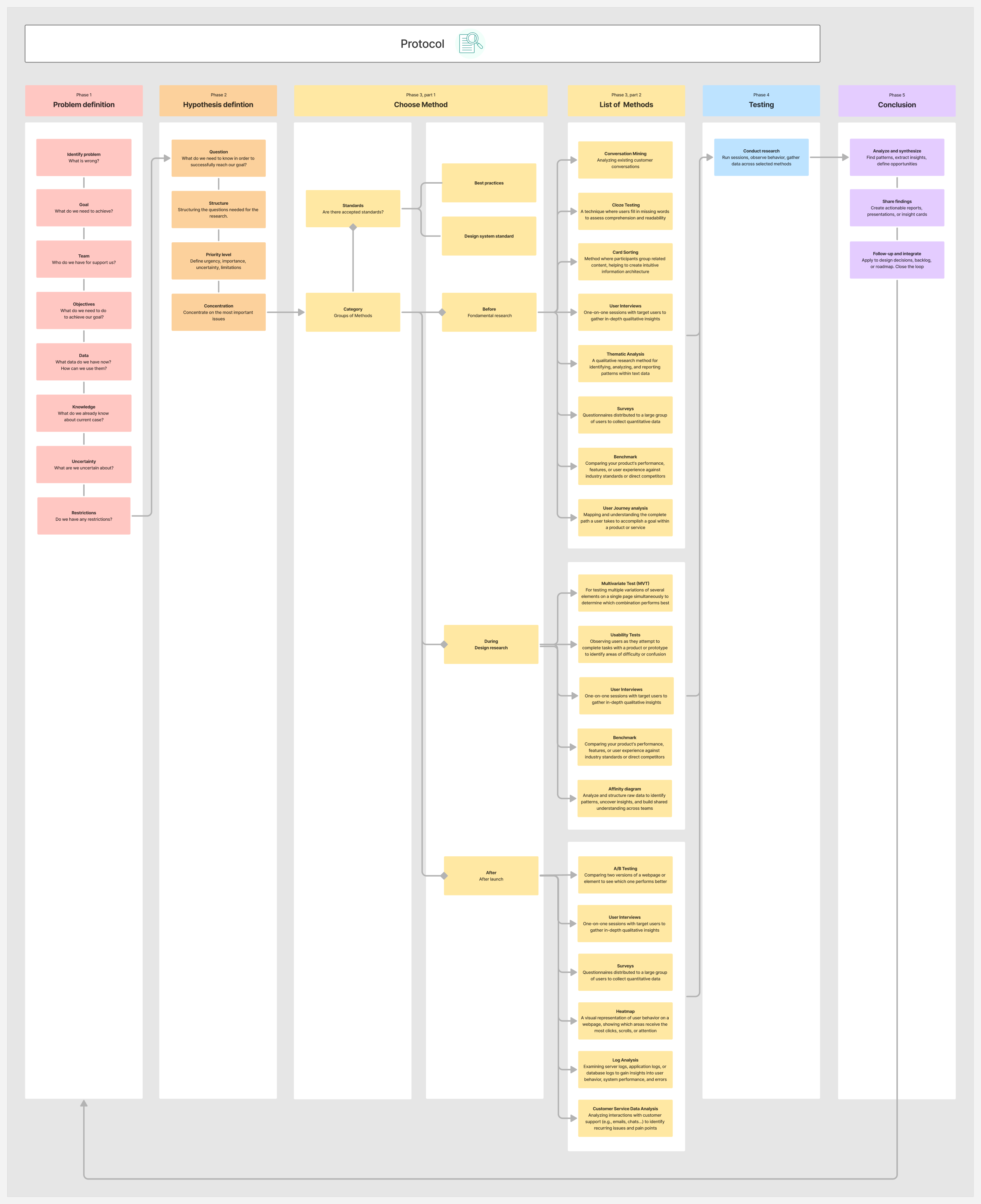
Shared design and research framework establishing a common language across the team
THE CHALLENGE
As the team's UX practice developed, methods, documentation, and research outputs varied between designers. Knowledge was dispersed, making reuse, onboarding, and stakeholder alignment more difficult.
MY CONTRIBUTION
Working with two other designers, I helped shape practical UX guidelines, research-method guidance, shared templates, and a research repository organised around Evidence → Insight → Recommendation. In January 2026 I introduced the Buddy System and those research guidelines as shared team practices. I also mentored two designers and co-led Figma workshops with another design lead.
Introduced in January 2026 to encourage earlier feedback, collaborative problem-solving, and knowledge sharing between designers. Participants reported the following.
Earlier identification of design issues.
Faster alignment, as reported by participants.
More opportunities to explore alternative solutions.
Better preparation before formal design reviews.
Established UX research guidelines and a shared repository in January 2026 so documentation would be more consistent and findings easier to find. At a reported checkpoint, 3 of 6 designers were using the repository — 50% adoption at that point in time. That figure is a historical checkpoint, not a claim about current adoption.
Mentored two designers through one year of formal mentorship, about 18 months including training. The emphasis was guidance, structured feedback, professional development, and supporting each designer to own their decisions.
Co-led more than five cross-functional Figma workshops with another design lead. The following changes were observed in how the group worked together.
Clearer understanding of design system components.
More use of design documentation.
Developers using exact Figma measurements rather than manual ruler-based approximations.
A stronger shared understanding between design, development, and QA.
RESEARCH FRAMEWORK
I proposed this five-step system and the names of its phases, from problem definition through conclusion.
Other designers aligned with it after testing the steps in practice. It is a way of structuring an inquiry, not a completed study, and not a record that every method was used.
PHASE 1
What is wrong?
What should we achieve?
Who can help?
What will get us there?
What data do we already have?
What do we already know?
What is still unclear?
What constraints apply?
PHASE 2
Organize and prioritize questions. This phase does not set a hypothesis.
What do we need to know?
Group the questions.
Rank urgency, importance, and uncertainty.
Focus on what matters most.
PHASE 3
Match methods to accepted standards and the lifecycle stage.
Check best practices and design-system standards.
Group methods by lifecycle stage.
Options by lifecycle stage. A method may appear more than once. Choose for the question. It is not a checklist. 19 methods across three stages.
Analyze existing customer conversations.
Ask users to fill in missing words to assess comprehension and readability.
Ask participants to group related content to help create intuitive information architecture.
Conduct one-on-one sessions with target users to gather in-depth qualitative insights.
Identify, analyze, and report patterns within qualitative text data.
Distribute questionnaires to a large group of users to collect quantitative data.
Compare a product's performance, features, or user experience against industry standards or direct competitors.
Map and understand the complete path a user takes to accomplish a goal within a product or service.
Test multiple variations of several elements on a single page simultaneously to determine which combination performs best.
Observe users completing tasks with a product or prototype to identify difficulty or confusion.
Conduct one-on-one sessions with target users to gather in-depth qualitative insights.
Compare a product's performance, features, or user experience against industry standards or direct competitors.
Analyze and structure raw data to identify patterns, uncover insights, and build shared understanding across teams.
Compare two versions of a webpage or element to see which performs better.
Conduct one-on-one sessions with target users to gather in-depth qualitative insights.
Distribute questionnaires to a large group of users to collect quantitative data.
Visualize user behavior on a webpage, including areas receiving the most clicks, scrolling, or attention.
Examine server, application, or database logs for insights into user behavior, system performance, and errors.
Analyze customer support interactions, such as emails and chats, to identify recurring issues and pain points.
PHASE 4
Run the selected methods and gather evidence.
Use only what the question, constraints, and stage require.
PHASE 5
Find patterns and name the opportunities.
Share what the team can act on.
Apply findings to design, the backlog, or the roadmap.
Follow-up feeds the next problem definition.
RETURN TO PROBLEM DEFINITION →SCOPE
2
DESIGNERS MENTORED
One year of formal mentorship, about 18 months including training.
2
UX PRACTICE INITIATIVES
Buddy System and research guidelines with a repository, January 2026.
5+
FIGMA WORKSHOPS
Cross-functional sessions co-led with another design lead.
50%
REPOSITORY ADOPTION
3 of 6 designers at a reported checkpoint, not current adoption.
KEY DECISIONS
Make guidance lightweight enough to use in everyday delivery.
Define consistent research documentation and minimum required fields.
Organise evidence, insights, and recommendations so findings are easier to understand and reuse.
Support designers with different experience levels through clear standards and knowledge sharing.
OUTCOME
The practice work gave the team a common language for research, a peer path for earlier feedback, and a clearer handoff conversation with engineering and QA. Repository use reached 3 of 6 designers at one reported checkpoint. Intended benefits include easier onboarding and more reusable research.
LEADERSHIP LENS
Shows how I strengthen the conditions for good design: shared practices, mentorship, and cross-functional influence beyond a single product. The repository figure is one historical checkpoint of early uptake.